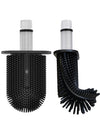
Not quite. "Rubber toilet brush" is a loose label. It can mean silicone rubber, or it can mean a cheaper thermoplastic rubber (TPR or TPE), and the two behave differently. Silicone handles heat better and keeps its shape for longer. The Moostar Soap Push uses a flexible silicone head, not TPR.
Quick answer: silicone is a type of rubber, but not every rubber toilet brush is silicone. Check the material line on the listing. "Silicone" means a heat-tolerant, non-porous head. "TPR" or "TPE" means a thermoplastic that softens at lower temperatures.
What is a rubber toilet brush made of?
Brushes sold as "rubber" usually use one of two material families:
- Silicone rubber. This is a synthetic elastomer built on a silicon-oxygen (siloxane) backbone. Materials database SpecialChem notes its "excellent resistance to attack by oxygen, ozone and sunlight", along with low chemical reactivity and wide temperature tolerance.
- Thermoplastic rubber (TPR) or thermoplastic elastomer (TPE). These are rubbery plastics that can be melted and re-moulded. Component maker Essentra describes TPE as "essentially a softer version of TPR". Both belong to the same thermoplastic family.
So a brush can honestly be called "rubber" whichever one it uses. That's why the material line matters more than the name.
Rubber vs silicone toilet brush: what's the difference?
| Silicone rubber | TPR / TPE ("rubber") | |
|---|---|---|
| Chemistry | Siloxane backbone; cured, so it does not re-melt | Thermoplastic; softens and can be re-processed with heat |
| Heat tolerance | Roughly 200-300°C (Xometry) | Roughly 130-150°C, above which it ages and cracks (Xometry) |
| Surface | Non-porous; grime rinses off easily (Which?) | Smooth when new; quality varies by grade |
| Recycling | Can't be re-melted into new parts | Can be re-processed after heating |
| Cost | Usually more expensive | Usually cheaper to make |
As manufacturing guide Xometry puts it, "The main difference between TPE and silicone is how they react to heat." In a bathroom, the brush won't meet anything like those temperatures. In practice, heat tolerance is a rough proxy for how stable the material stays over time.
Is a silicone toilet brush better than a rubber one?
For most homes, silicone is the safer choice when you can't tell which grade of "rubber" you are getting. Which? says that in theory "silicone is non-porous, so it's less likely to harbour bacteria and grime rinses off it more easily". It also found that newer silicone brushes often have an edge over traditional nylon bristles.
A TPR head can still clean well, and it is cheaper. What matters is the bristle design (how long, how dense and how flexible the bristles are) and whether the head reaches under the rim. For more on the hygiene question, read our guide to what experts say about silicone vs bristle toilet brushes.
How to tell if a "rubber" toilet brush is really silicone
- Read the material line, not just the title. Look for "silicone". "TPR", "TPE" or "thermoplastic" means it isn't silicone.
- Ask if it's unclear. If the listing just says "rubber", ask the seller which material it is before you buy.
- Look for spare heads. Brands that sell replacement silicone heads usually say so clearly.
- Check the handle. A good head on a bendy plastic stick won't get under the rim with any pressure.
Do rubber toilet brushes clean as well as bristles?
Flexible silicone or rubber heads bend into the curve of the bowl and up under the rim. Water and debris also run off them rather than getting trapped between dense nylon strands. Stiff nylon can feel more aggressive on old stains. For stubborn marks, use a descaler or toilet cleaner and give it time to work, whichever brush you own. We cover this in does poo stick to silicone toilet brushes.
Moostar Soap Push: a silicone toilet brush, not TPR
This section is about our own product. Erica founded Moostar to make a toilet brush that's easy to keep clean. The Moostar Soap Push has:
- A flexible silicone head with short silicone tips for everyday build-up and long silicone bristles that reach under the rim
- A replaceable head that comes off with a one-push, hands-free release. Replacement silicone heads cost £9.99
- A built-in cleaner reservoir in the 304 stainless steel handle: press to release cleaner onto the head
- A sealed base unit that keeps drips contained, wall-mounted with adhesive or freestanding
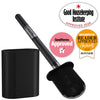
Awards: Good Housekeeping Institute Approved 2026. Winner, Best Toilet Brush, woman&home Reader Approved Awards 2026 (9.2/10), where a reader said it is "really well designed and looks stylish". Also GoodHomes Approved: "It's Good Homes Approved!"
Prices: Stainless Steel, Black and Grey are £17.99. Luxe Copper, Gold and Chrome are £25.99. The brush plus spare head bundle is £25.88. Delivery is free in the UK on orders over £10, orders are dispatched within 1-2 working days, and there are 90-day returns. We deliver to the UK only.
Honest limitations: silicone costs more than TPR. A silicone head feels softer than stiff nylon, so heavy limescale may need a descaler first. And like any brush head, it will eventually need replacing.
Browse all our toilet brushes and holders, or compare the main types in our Best Toilet Brush UK 2026 guide.
Verdict
A rubber toilet brush can be silicone, but often it's a thermoplastic. If the listing says silicone, you get a non-porous, heat-stable head that rinses clean. If it says TPR or TPE, expect a cheaper material that is less tolerant of heat. Either way, check the head design and whether you can buy spares.
Frequently asked questions
Is silicone the same as rubber?
Silicone rubber is a type of rubber, made on a silicon-oxygen backbone. Not all rubber is silicone, though. Thermoplastic rubber (TPR) is a different material.
What is TPR on a toilet brush?
TPR is thermoplastic rubber. It's a flexible plastic that can be re-melted and moulded, and it's usually cheaper than silicone, with lower heat tolerance.
Are rubber toilet brushes hygienic?
Smooth, flexible heads tend to rinse cleaner than dense bristles. Which? says silicone in particular is non-porous, so grime rinses off more easily.
How do I clean a rubber or silicone toilet brush?
Rinse it in the flush, let it drip over the bowl, then put it back in the holder. Wash the head and holder regularly with your usual toilet cleaner.
Can I replace just the head on a silicone toilet brush?
On some models, yes. The Moostar Soap Push takes replacement silicone heads, so you keep the handle and holder.